How To Write YouTube Scripts With AI: The Storytelling Formula That Holds Attention
There is a belief that gets in the way of a lot of new channels: that a video only takes off if the idea behind it is something nobody has thought of before.
Look at the history of the platform and the opposite is closer to the truth. Most of the videos that worked were improved versions of something that had already worked. Not copies. Improvements. That distinction is the whole craft, and it is where I start whenever I write for an English-speaking audience.
Why well-made videos still get no watch time
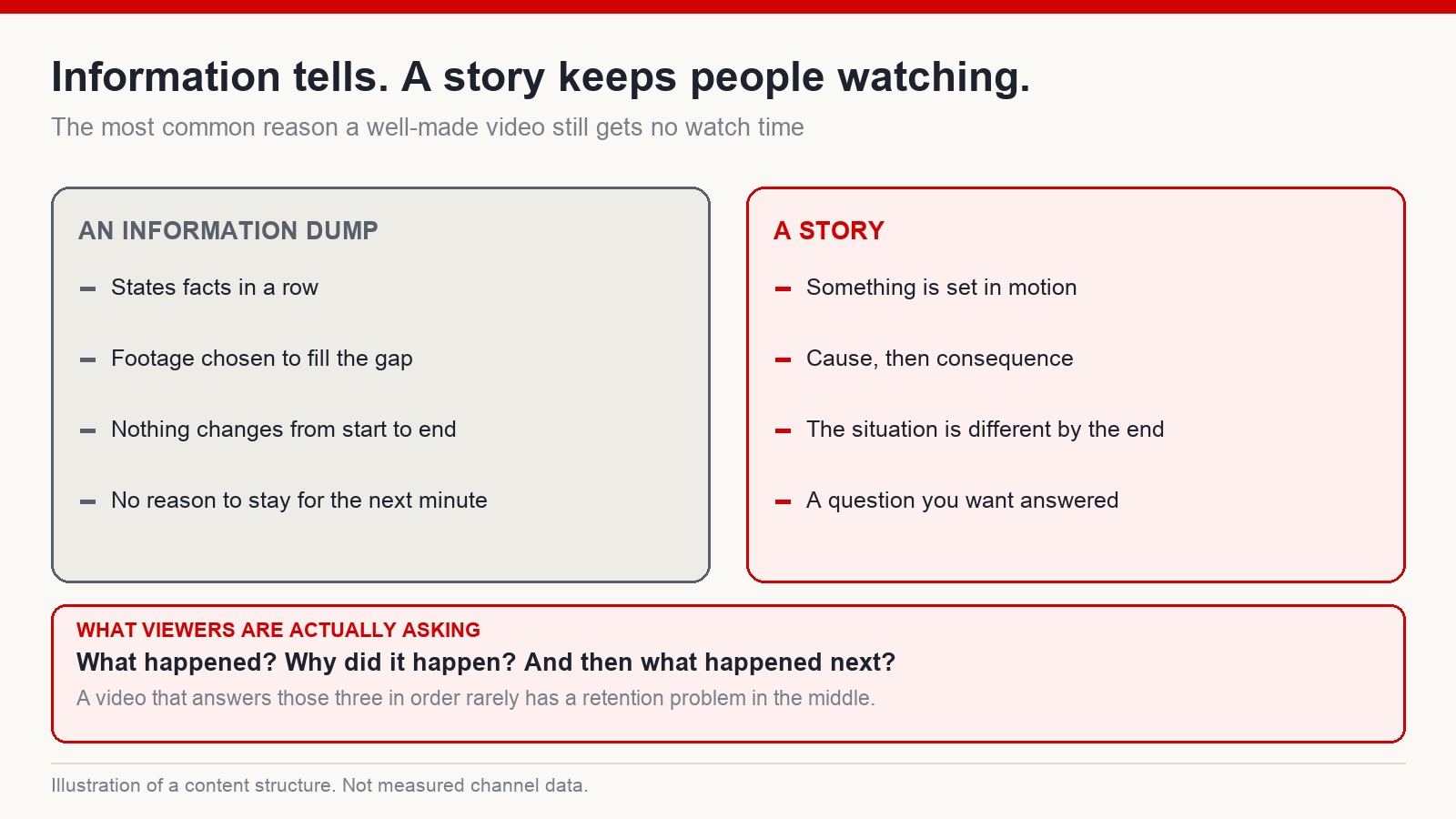
I have looked at a lot of new channels. The most common problem is not production quality. It is that the video has no story in it.
The pattern is easy to recognise. Facts stated in a row. A list of things worth knowing. Footage chosen to fill the gap under the narration. Nothing changes between the first minute and the last, so there is never a reason to stay for the next one.
What people actually want from a video is a sequence. Something happens. It happens for a reason. And then something follows from it. That shape is what keeps someone watching, and it is available to you whatever your subject is.
Copying well: shu, ha, ri
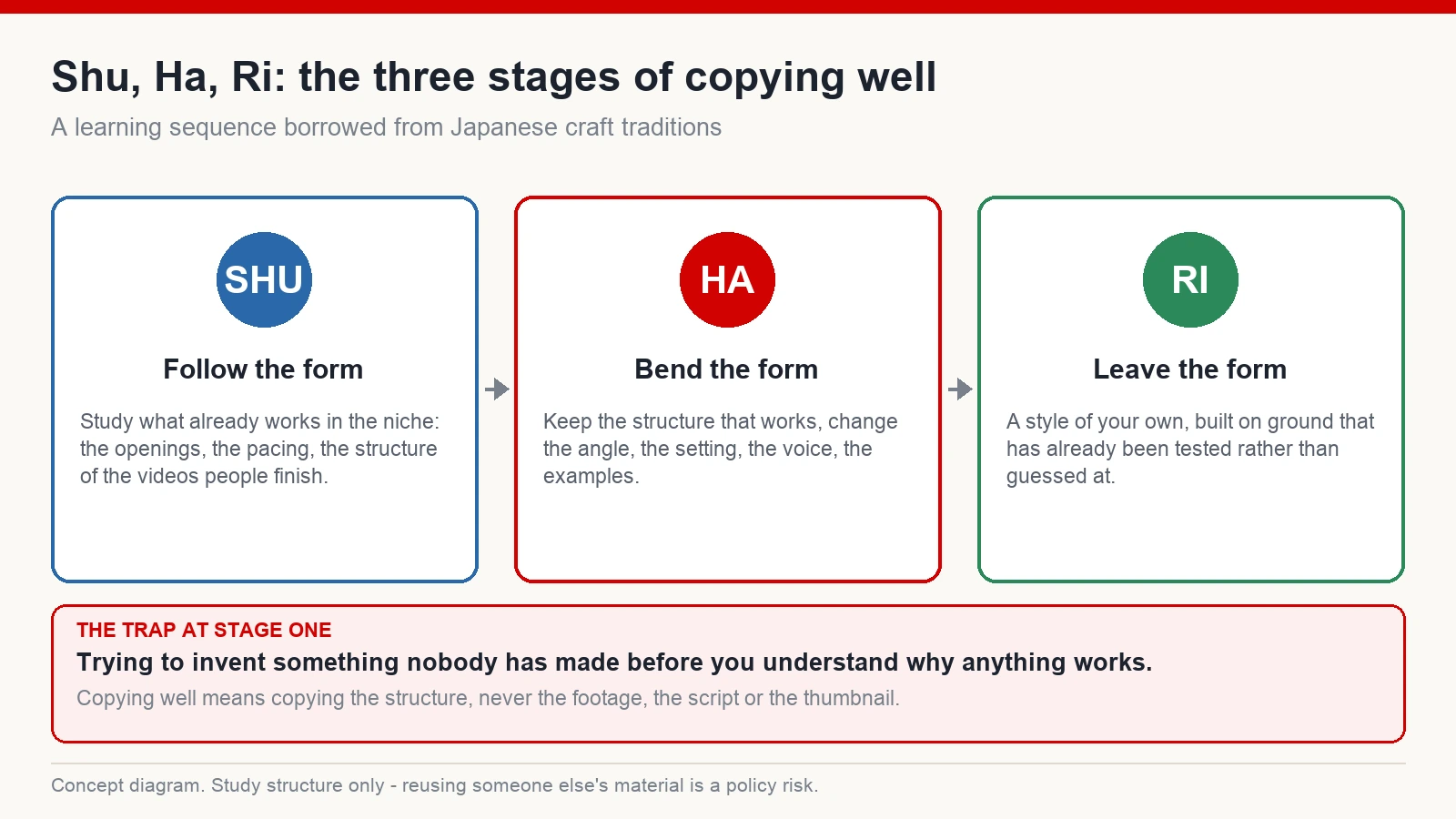
Japanese craft traditions describe learning in three stages, and the sequence maps onto this work almost exactly.
Shu: follow the form
Before inventing anything, study what already holds attention in your niche. Watch the videos people finish. Work out what the opening promises, how the pacing moves, where the turn happens, and what the ending does.
The point is to understand why viewers stay. To be unambiguous about what this does not mean: never reuse someone’s footage, script or thumbnail. Structure is not owned by anyone. Material is.
Ha: bend the form
Once you understand the structure, start changing things around it. A different angle on the subject. A different setting. A different narrator persona. A different set of examples. The skeleton is proven; the flesh is yours.
Ri: leave the form
Eventually a style emerges that is recognisably yours, built on ground you have already tested rather than ground you guessed at. You will not get here by starting here. Trying to invent something before you understand why anything works is the single most reliable way to slow yourself down.
The three-question formula
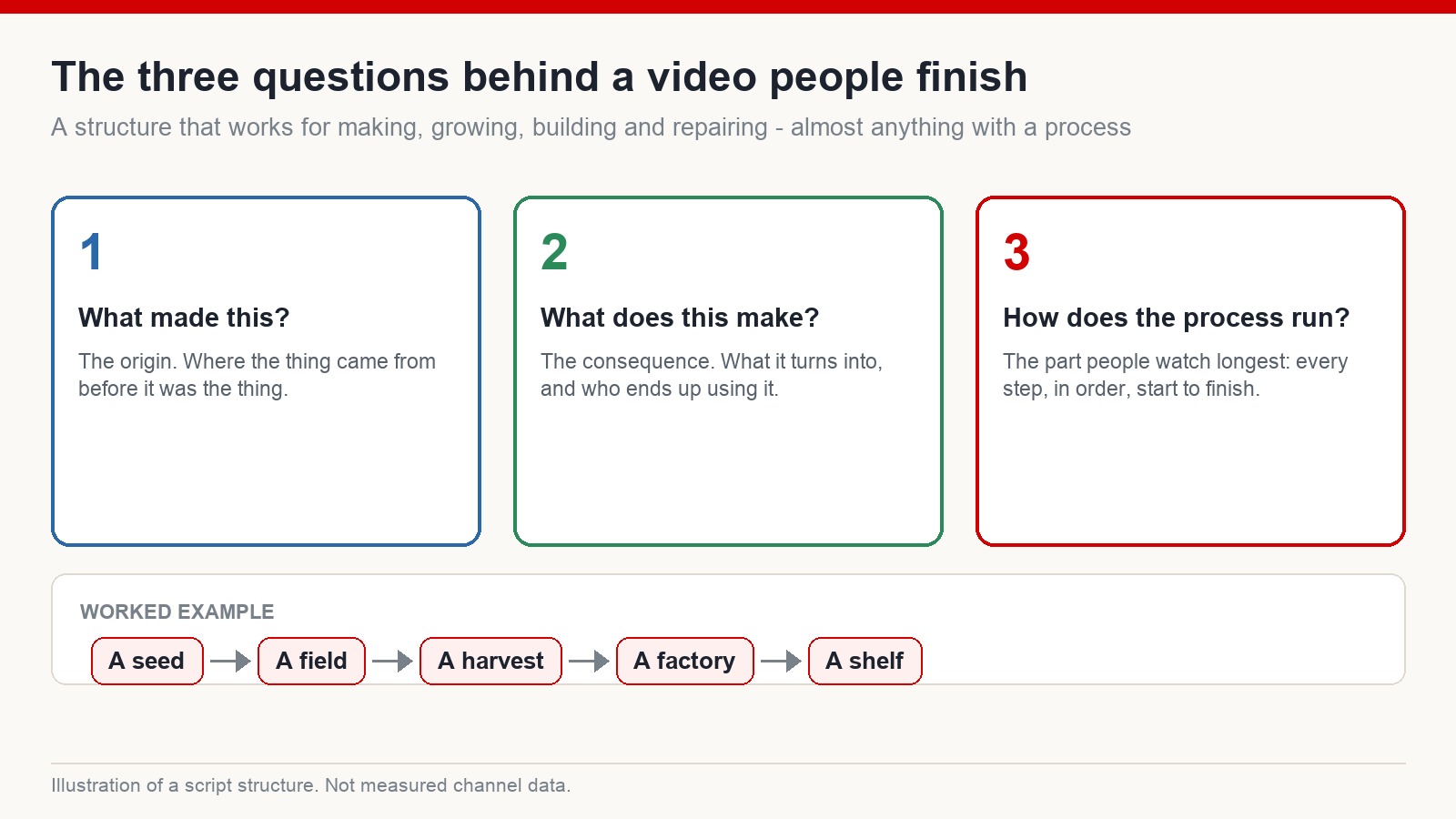
If I had to compress everything I know about holding attention into one structure, it would be three questions. They work for making, growing, building, repairing, almost anything with a process in it.
What made this?
The origin. Where the thing came from before it was the thing. How a seed becomes a plant. What a duckling hatches out of. What a car was before it was a car. People are reliably curious about beginnings.
What does this make?
The consequence. What it turns into, and who ends up using it. Where the finished product goes. What the grown animal does next. This is the question that pulls a viewer forward rather than holding them in place.
How does the process run?
This is the part people watch longest. Humans are strangely absorbed by processes: every step, in order, start to finish. It explains why videos about manufacturing, farming and repair hold attention far better than their subject matter suggests they should.
Writing the script with an AI assistant
Drafting tools have cut the time this takes considerably. They have not replaced the thinking, and the videos where someone let them try are easy to spot.
Write in your strongest language first
If you are producing for an audience that does not share your first language, draft in your own language before you translate. You will feel where the story sags, notice the hole in the logic, and hear when a line is flat. None of that survives writing directly in a language you are still working in. Translate afterwards, once the story is sound.
Use the model to widen, not to decide
Drafting tools are good at finding the sub-niche inside your niche, laying out a structure, expanding a thin section, and generating a list of adjacent video ideas. That saves hours of staring at a blank page.
What they are not good at is deciding which of those ideas is worth your week. That judgement is yours, and it is the part that compounds.
Finish the story before you translate
Before anything goes into a translator, check four things. Does the story hold together logically? Does it create curiosity early? Is there any feeling in it? Is there something the viewer takes away? If all four are yes, translate. If not, fixing it in the second language is much harder than fixing it in the first.
The assistant is not the storyteller
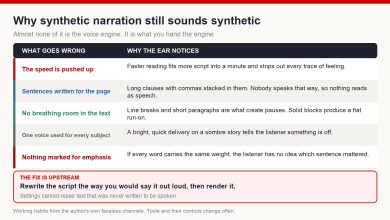
A drafting tool writes quickly, summarises quickly and translates quickly. It has not lived your life, does not carry your experience, and has no opinion about anything.
The difference between a video that gets watched and a video that gets scrolled past is almost always a human point of view. A thousand people can describe the same journey. Only you can describe it the way you saw it. That is what builds an audience that comes back, and it is the one thing no tool supplies.
Evergreen material outlasts trend material
Trends are tempting because the payoff is immediate. They are also short-lived: viral today, invisible next month.
A video built on something that does not expire can keep finding viewers for years. Production processes. Historical material. Puzzles. Geography. Animals. Science. These accumulate rather than spike, and after fifty of them you have something closer to a library than a feed.
Neither approach is wrong. But if you are choosing where to spend limited time, the evergreen side of the ledger is where the work keeps paying attention forward.
Narrower subjects are easier to win
A video made for everyone usually turns out to be a video for nobody.
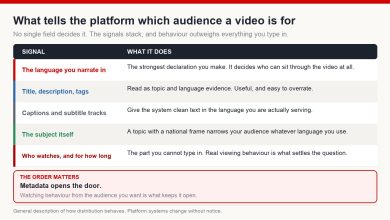
Instead of a channel about animals, make one about seabird rescue. Instead of a channel about agriculture, make one about mechanical coconut harvesting. The narrower the subject, the easier it is for the platform to work out who to show it to, and the easier it is for a viewer to decide it is for them.
This also makes the writing easier, which people rarely mention. A specific subject suggests its own questions. A broad one leaves you inventing angles from nothing.
Common questions
Should AI write the whole script?
No. Use it as an assistant for structure and speed. The perspective, the feeling and the specific details need a human editing pass, or the video sounds like everything else in the niche.
Why draft in my own language before translating?
Because you can judge story logic and emotional weight far more accurately in the language you think in. Translate once the story is already working.
What does evergreen content mean?
Material that stays useful and searched long after it is published, as opposed to content tied to a moment that stops being relevant when the moment passes.
How do I improve retention?
Give the video a shape: cause, then consequence, then process. Keep a question open across the whole thing. Retention problems in the middle of a video are usually structure problems, not editing problems.
Is studying competitors risky?
Studying structure is normal research. Reusing footage, scripts or thumbnails is a copyright and policy risk. Keep the line clear and you are fine.
Where to start
Writing for an international audience is not a competition to be the most original. It is a competition to understand viewers best.
Find something in your niche that already works. Learn its shape. Tell your own story inside that shape, built around cause, consequence and process. Use a drafting tool to move faster, then put your own perspective back into the result.
Do that consistently and you are not producing videos, you are building a body of work that keeps earning attention for years. If you want to see how I approach this for English-speaking audiences from the ground up, that is what I work on at mmoyoutube.com.